Living Code: Refactoring Biology and Synthetic Logic in the Age of CRISPR
A software engineering perspective on life's quaternary (A-T-G-C) operating system: Genetic bugs, CRISPR-Cas9 as a molecular regex engine, and biological logic gates.
Introduction: The Quaternary Operating System
As software developers or hardware engineers looking at a screen, we know that everything at the fundamental level reduces to two physical states: voltage present or absent; 1 or 0. The vast architecture of our silicon world, from cloud hyperscalers to microcontrollers in our pockets, rests entirely on this binary logic. Yet when we step into the laboratory and look through the microscope, we witness nature executing a far more sophisticated architecture for nearly four billion years: a chemical operating system running on a quaternary (base-4) foundation.
Instead of 0 and 1, biology’s source code—DNA—utilizes four nucleotide bases: Adenine (A), Thymine (T), Guanine (G), and Cytosine (C).
DNA is often mistakenly perceived as a passive hard drive or a read-only database storing genetic information. Viewed from first principles, however, the reality is entirely different: A living cell is a self-compiling, self-assembling computational engine that reads its source code (Transcription), converts it into intermediate bytecode (mRNA), and translates it into three-dimensional, functional nanoscale protein machinery (Translation) via molecular compilers known as Ribosomes.
Furthermore, the information density of this substrate dwarfs anything possible in silicon. A single gram of DNA can theoretically store roughly 215 petabytes (215 million gigabytes) of data and preserve it for millennia under ambient conditions without consuming a single watt of idle power.
Genetic Bugs and Mutations
No codebase runs without flaws; in a biological codebase spanning 3.2 billion base pairs (the human haploid genome), errors during transcription or replication are mathematically inevitable. In biology, what we call a mutation is the direct equivalent of a software bug.
Let us categorize these molecular errors through the lens of a software engineer:
- Syntax Errors and Point Mutations: A single misplaced character in the code (e.g., swapping
AforT) creates a Single Nucleotide Polymorphism (SNP) or point mutation. Sickle cell anemia is the classic example of such a single-character typo: a single base change in the gene encoding the hemoglobin subunit deforms the three-dimensional folding of the entire protein. - Frameshift and Off-by-One Errors: The ribosomal compiler parses code in triplets known as codons (
ATG-CGA-TTC...). Inserting or deleting a single nucleotide shifts the entire downstream reading frame (frameshift mutation). Much like pointer corruption in lower-level software, all subsequent downstream codons become garbled data, almost always triggering an untimely prematureSTOPcodon that crashes the program. - Runtime Errors and Epigenetic Misconfigurations: Occasionally, your source code (DNA sequence) is completely pristine; the static syntax check passes without warning. However, during runtime, environmental stressors or aberrant methylation tags cause the right gene to be expressed at the wrong time or in pathological concentrations. Many forms of cancer stem not merely from mutated code, but from cellular subroutines trapped in infinite
while(true)loops that have lost theirbreakconditions (apoptosis / programmed cell death).
💡 Engineering Insight: Evolution treats these copying errors not as bugs, but as continuous, planetary-scale A/B testing. While the vast majority of mutations crash the system, the one-in-a-million beneficial mutation grants the organism a competitive edge in production (nature).
CRISPR-Cas9: A Molecular Patch and Regex Engine
For decades, molecular biologists were largely confined to reading the genome (sequencing) or applying blunt, stochastic chemical mutagens. That changed fundamentally with the adaptation of CRISPR-Cas9—a bacterial adaptive immune system refined over billions of years—into a programmable gene-editing tool.
The most accurate conceptual model for CRISPR-Cas9 is an IDE’s Find & Replace engine or the Unix command-line utilities grep and sed:
- gRNA (Guide RNA) — The Regex Query: A sequence of approximately 20 nucleotides that specifies exactly where inside the 3.2-billion-character codebase the modification must occur. Like a regular expression, it identifies the target locus with extraordinary specificity.
- PAM Sequence (Protospacer Adjacent Motif) — Permission Check: Before the Cas9 endonuclease can bind and cleave the DNA, it requires a specific adjacent signature (such as
NGG). This functions as a cryptographic checksum and permission token, preventing the bacterium from accidentally shredding its own CRISPR array. - Cas9 Endonuclease — The Molecular Scissors and Patcher: Once the guide RNA hybridizes to the target sequence, Cas9 cleaves the double helix, inducing a Double-Strand Break (DSB). By hijacking the cell’s endogenous repair pathways (NHEJ or HDR), engineers can either knock out a defective gene (commenting it out) or insert an exogenous synthetic DNA donor template as a hot-patch.
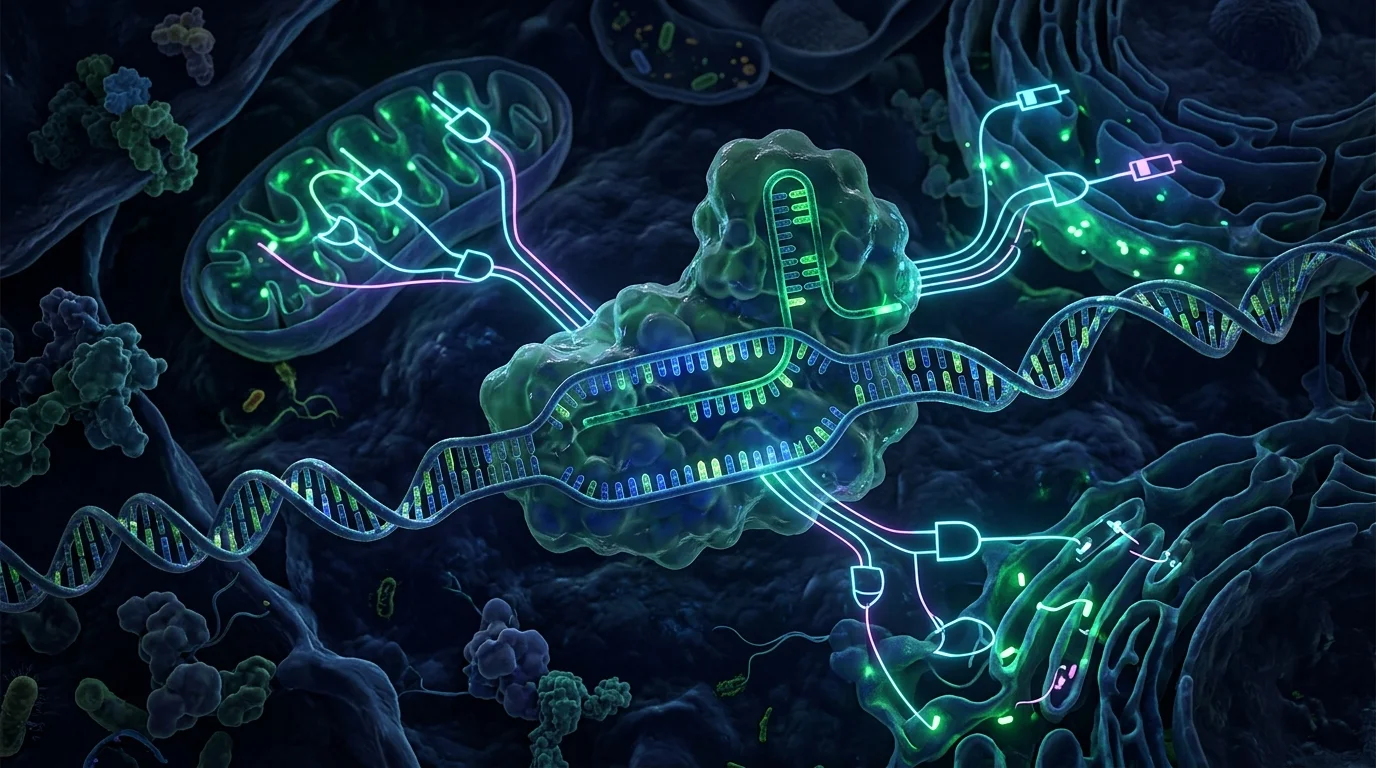 Figure: The CRISPR-Cas9 molecular complex performing high-fidelity DNA refactoring alongside biological logic gates.
Off-Target Effects: Biological Regression Bugs
If you run a careless regex Find & Replace across a large enterprise codebase, you risk modifying identically named identifiers in unrelated microservices, introducing critical regression bugs. In biology, this is termed an Off-Target Effect.
When the gRNA binds to a genomic locus with 85–90% homology instead of 100% fidelity, Cas9 can introduce cuts in unintended regions, potentially knocking out a critical tumor suppressor gene. Contemporary gene editing paradigms, such as Base Editing and Prime Editing, address this risk by rewriting individual nucleotides without making double-strand breaks, providing clean, single-point patches.
Biological Logic Gates (Bio-Circuits)
Synthetic biology does not stop at patching existing code; it architects entirely new logical circuits inside living cells. The logic gates that electrical engineers etch into silicon using MOSFETs are implemented biologically through Gene Regulatory Networks (GRNs).
A gene’s upstream Promoter and its corresponding Transcription Factors function analogously to the gate terminal of a field-effect transistor, regulating transcriptional flux:
- NOT Gate (Inverter): When molecule A is present ($\text{Input} = 1$), a transcriptional repressor protein binds to the operator/promoter, halting transcription ($\text{Output} = 0$). In the absence of A, transcription proceeds unimpeded, synthesizing Green Fluorescent Protein (GFP) ($\text{Output} = 1$).
- AND Gate: Both molecule A and molecule B must be simultaneously present to initiate transcription. For example: “Produce the therapeutic cytotoxic payload ($\text{Output} = 1$) IF AND ONLY IF hypoxia is detected ($\text{Input}_1 = 1$) AND a specific oncogenic biomarker is present ($\text{Input}_2 = 1$).” This is the fundamental algorithm powering next-generation smart cellular therapies.
- OR Gate: A redundant circuit where transcription is triggered if either promoter pathway is activated.
Deterministic Silicon vs. Stochastic Biology
When you write if (A && B) in C++ running on an ARM or ESP32 microcontroller, the outcome is deterministically high (3.3V) if both conditions hold. Silicon is deterministic; electrons traverse copper interconnects at near light speed with predictable physics.
A living cell, however, is not a printed circuit board. It is a hot, crowded, highly turbulent aqueous solution where molecules collide via Brownian motion. Biological circuits are stochastic (probabilistic). When you design a biological AND gate, binding kinetics, thermodynamic fluctuations, and transcriptional burst noise ensure the output is not a sharp square wave, but a continuous probability distribution. The primary challenge in synthetic biology is engineering robust, noise-tolerant biological state machines out of this inherently stochastic substrate.
Engineering Comparison: Silicon Processors vs. Biological Cells
Contrasting digital processors (The Cornerstone of the Digital Universe: Transistor Wars) with nature’s biological computing units reveals profound architectural differences:
| Engineering Metric | Silicon Compute (CPU / MCU) | Biological Cells (Living Substrates) |
|---|---|---|
| Logic Base | Binary (0, 1) | Quaternary (A, T, G, C) |
| Switching Element | Transistor (FinFET / GAAFET) | Promoters & Transcription Factors |
| Clock Frequency | Ultra High ($\text{GHz}$ — Billions of cycles/sec) | Low ($\text{mHz}$ – $\text{Hz}$ — Seconds to minutes) |
| Concurrency | Limited by physical core count | Massive (Trillions of molecular reactions in parallel) |
| Energy Consumption | High ($\text{Watts}$ to $\text{Kilowatts}$, significant thermal dissipation) | Ultra Low ($\sim\text{Picowatts}$ per cell, ATP-driven) |
| Operational Dynamics | Deterministic and Digital | Stochastic (Probabilistic) and Hybrid Analog-Digital |
| Fault Tolerance & Repair | Low (Single transistor failure can crash a die) | Exceptionally High (DNA repair enzymes, autophagy, self-replication) |
Conclusion: Refactoring the Legacy Code of Life
For centuries, biology was an observational science; we documented and reverse-engineered the complex legacy code left behind by natural selection.
Today, through Bioengineering and Synthetic Biology, we are crossing into an unprecedented era. We are no longer passive code reviewers; we are systems architects sitting before the biological IDE, refactoring metabolic pathways, patching hereditary bugs via CRISPR, and compiling entirely novel computational logic into living cells.
Humility remains essential when modifying a codebase with four billion years of technical debt, as the full extent of genomic side-effects is still being mapped. Yet one truth is becoming abundantly clear: The most transformative software of the 21st century will not run exclusively on silicon chips—it will compile and execute within the living cell.
Author: Kerem Uysal — Founder, Tech&Lab
Contact: info@keremuysal.com | info@techandlab.com