Beyond Silicon: DNA Data Storage and Biological Memory
Nature's 4-billion-year-old answer to the zettabyte storage crisis: From DNA synthesis to Nanopore sequencing, Reed-Solomon and DNA Fountain error correction mathematics, and biological memory architecture from first principles.
In my earlier analysis on Tech&Lab, “The Cornerstone of the Digital Universe: Transistor Wars”, we examined how our digital civilization is sustained by the switching of 28 billion transistors inside an Apple M4 processor, dancing at the atomic limits of silicon as we transition from Planar FETs to FinFET and GAAFET nanosheet architectures. For half a century, Moore’s Law served as an economic and physical engine scaling compute power exponentially.
Yet compute is not the only physical wall looming over modern computer architecture and cloud hyperscalers. An equally daunting, thermodynamically punishing, and exponentially accelerating second crisis is unfolding before us: The Data Storage Crisis.
As a bioengineering student working with micropipettes and transparent tubes of DNA in the morning, and analyzing low-level hardware architectures at my terminal by night, I find myself repeatedly drawn to a fundamental question: In an era where silicon is hitting atomic barriers, why aren’t we leveraging the carbon-based molecular hard drive that nature has perfected over four billion years?
The answer takes us on an extraordinary engineering journey from semiconductor physics to synthetic biology, organic chemistry, and information theory.
1. Introduction: The Storage Crisis of the Zettabyte Era
The volume of data generated by human civilization is expanding substantially faster than our capacity to manufacture silicon wafers and magnetic platters. The global datasphere, coursing through fiber optic backbones, 5G networks, satellite constellations, and hyperscale cloud clusters, has breached the Zettabyte frontier:
\[1 \text{ Zettabyte (ZB)} = 10^{21} \text{ Bytes} = 10^{9} \text{ Terabytes (TB)}\]Dataset pipelines for frontier AI training, autonomous vehicle sensor logs, particle physics outputs from CERN, and bioinformatic genomic repositories continuously accelerate this deluge. Where and how are we physically storing this ocean of information?
First-Principles Limits of Silicon and Magnetic Storage
Examined from first principles, every modern digital storage medium relies on metastable physical states trapped behind energy barriers:
- NAND Flash (SSDs): Encodes information as charge trapped in floating-gate or charge-trap dielectric layers. As node geometries shrink, quantum mechanical tunneling causes electrons to escape the gate oxide (charge leakage). Store an unpowered SSD on a shelf at room temperature, and bit rot sets in within a few years; its reliable operational lifespan rarely exceeds 5 to 10 years.
- Magnetic Tape (LTO) and Hard Disk Drives (HDDs): Form the backbone of cold storage in enterprise data centers, relying on ferromagnetic domains. However, thermal agitation (the superparamagnetic limit) and chemical degradation of polymer binders constrain even the most advanced LTO tapes to 10 to 20 years.
Analogy — Sandcastles and Perpetual Migration: Current enterprise data centers are akin to building elaborate sandcastles against an oncoming tide. Because entropy and charge leakage wear them down every decade, technology companies spend billions perpetually copying legacy bits onto new physical drives (continuous data migration). Immense power is consumed not to compute, but merely to prevent civilization from forgetting its past.
2. Nature’s 4-Billion-Year-Old Hard Drive: DNA
If we set aside legacy hardware paradigms and engineered an ideal archival medium from scratch, physics and chemistry would demand three essential traits:
- Volumetric (3D) Molecular Density: Information packed not across 2D planar surfaces, but encoded directly into covalent bonds at the sub-nanometer scale.
- Zero Idle Power: Zero electrical power consumed to retain information once written.
- An Eternal, Immutable Reader: Floppy disks, CD-ROMs, and early tape drives became obsolete in decades. Yet as long as human civilization survives, we will always maintain the technology to sequence and read our own biological code.
Nature resolved this engineering challenge roughly 4 billion years ago: Deoxyribonucleic Acid (DNA).
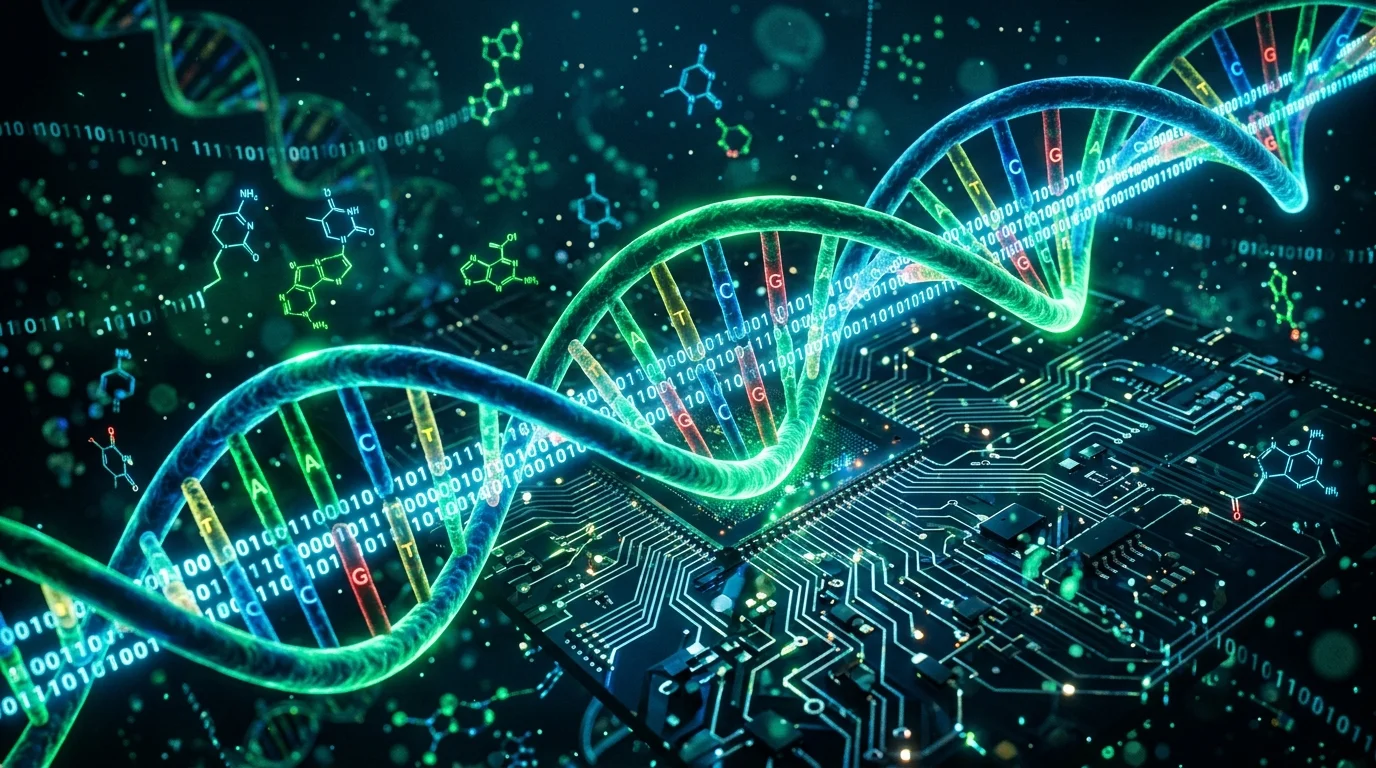 Figure: The volumetric density leap from planar silicon transistor arrays to 3D DNA macromolecules.
215 Petabytes in a Single Gram: The Information Density
DNA is a biopolymer composed of four nitrogenous bases: Adenine (A), Thymine (T), Cytosine (C), and Guanine (G) arranged along a sugar-phosphate backbone.
From Shannon’s information theory, each nucleotide position provides 4 discrete states, yielding a theoretical capacity ($I$):
\[I = \log_2(4) = 2 \text{ bits / nucleotide}\]At the molecular scale:
- The inter-base distance along a double-stranded DNA helix is merely $0.34 \text{ nm}$ ($3.4 \text{ Å}$)—dramatically smaller than the gate lengths of sub-3nm GAAFET nodes.
- The average molecular weight of a deoxynucleotide monophosphate is $\sim 330 \text{ g/mol}$. Utilizing Avogadro’s number ($N_A \approx 6.022 \times 10^{23} \text{ mol}^{-1}$), the mass of a single nucleotide ($m_{\text{base}}$) is:
At the theoretical limit of $2 \text{ bits}$ ($0.25 \text{ bytes}$) per nucleotide, one gram of single-stranded DNA can hold:
\[\text{Theoretical Max} = \frac{0.25 \text{ bytes}}{5.48 \times 10^{-22} \text{ g}} \approx 4.56 \times 10^{20} \text{ bytes/g} = 456 \text{ Exabytes / gram}\]In real-world engineering, indexing headers, primer binding sites, and error-correcting codes (ECC) introduce overhead. In their landmark Science paper, Yaniv Erlich and Dina Zielinski demonstrated that accounting for all practical physical constraints, 1 gram of DNA reliably stores $\mathbf{215 \text{ Petabytes}}$ ($2.15 \times 10^{17} \text{ bytes}$).
To visualize this: 215 Petabytes—equivalent to 215,000 one-terabyte hard drives—condenses into a dry pellet smaller than a single drop of water.
Mammoth DNA and Million-Year Durability
DNA’s defining virtue is not merely density, but the immense thermodynamic stability of its covalent phosphodiester backbone. Paleogeneticists regularly extract and sequence readable genomic fragments from 1.2-million-year-old mammoth molars recovered from Siberian permafrost.
The principal agents of DNA decay are water (hydrolytic deamination), oxygen (oxidative degradation), and ultraviolet radiation. When synthetic DNA is encapsulated inside microscopic silica glass spheres (synthetic fossilization) and desiccated, it can be preserved with zero energy consumption ($0 \text{ W}$) for millennia without losing a single bit.
3. Writing the Code (Synthesis): Compiling 0s and 1s into A, T, C, G
To commit a binary file (an OS kernel, an ISO image, or an archive) to DNA, we must construct a compiler translating silicon’s binary language (Base-2) into biology’s quaternary language (Base-4).
The Homopolymer Trap and Biochemical Constraints
A naive mapping assigns two bits per nucleotide:
\[\begin{aligned} 00 &\longrightarrow \text{A (Adenine)} \\ 01 &\longrightarrow \text{C (Cytosine)} \\ 10 &\longrightarrow \text{G (Guanine)} \\ 11 &\longrightarrow \text{T (Thymine)} \end{aligned}\]Feeding this naive bitstream into chemical synthesizers results in immediate failure due to biochemical constraints:
- Homopolymer Runs: Long streams of zeros (
000000000000) map to repetitive strings likeAAAAAA. Identical consecutive bases ($>3$) are called homopolymers. Chemical synthesizers stumble during addition cycles, and sequencers cannot accurately resolve whether five or six consecutive bases passed through the sensor, inducing catastrophic frameshift (indel) errors. - GC-Content Skew: Adenine pairs with Thymine via 2 hydrogen bonds ($\text{A}=\text{T}$), while Guanine pairs with Cytosine via 3 hydrogen bonds ($\text{G}\equiv\text{C}$). If the GC ratio spikes above 60%, the melting temperature ($T_m$) surges, forming secondary hairpin structures. If it dips below 40%, duplex hybridization destabilizes. The acceptable window is:
Overcoming Homopolymers: Rotation and Scrambling
Information theorists utilize two robust strategies:
- Ternary Base-3 Rotation (Goldman Algorithm): Converts binary streams into ternary (${0, 1, 2}$). Each incoming trit selects one of the three bases different from the preceding base. This guarantees that no base ever repeats consecutively.
- XOR Scrambling & Constrained Coding: Verifiably balanced pseudo-random keys are $\text{XOR}$ed with payload blocks, filtering out runs with homopolymers or extreme GC skews.
Chemical vs. Enzymatic Synthesis
Phosphoramidite Chemical Synthesis: The four-decade-old cyclic standard (Deblocking $\to$ Coupling $\to$ Capping $\to$ Oxidation) achieves stepwise coupling efficiencies ($\eta \approx 99.5\%$). However, synthesis yield ($Y$) drops exponentially with sequence length ($L$):
\[Y = \eta^L = (0.995)^{200} \approx 36.7\%\]Consequently, rather than synthesizing a megabase chromosome, DNA storage borrows from TCP/IP packetization: data is partitioned across millions of short oligos (150–300 bp), each bearing packet addresses, file identifiers, and checksums.
Enzymatic Synthesis (TdT): Terminal Deoxynucleotidyl Transferase adds nucleotides in aqueous buffer without requiring a template strand. Paired with reversible terminators and CMOS microelectrode arrays, enzymatic printers enable direct, parallel synthesis of DNA packets on silicon surfaces.
Analogy — The Bio-Foundry Model: Just as TSMC unbundled semiconductor manufacturing from chip design, companies like Twist Bioscience serve as the bio-foundry layer, printing millions of oligonucleotides in parallel across silicon flowplates for fabless data architects.
4. Reading the Code (Sequencing): Optical NGS vs. Oxford Nanopore
Once millions of oligonucleotides are pooled in a single microtube, how do we query a specific file (Random Access) and decode it back to bits?
Molecular Random Access via PCR
In DRAM or flash, a memory controller asserts a physical address bus. In an oligo pool, random access is governed by molecular thermodynamics.
Every file is flanked by a unique 20-base pair forward and reverse primer sequence. To retrieve File_42:
- Take a micro-aliquot from the master pool.
- Add primers matching
File_42alongside DNA polymerase. - Initiate Polymerase Chain Reaction (PCR) thermal cycling.
With each cycle, target strands amplify exponentially:
\[N_c = N_0 \cdot (1 + E)^c \approx N_0 \cdot 2^c\]Within 25–30 cycles, target molecules are amplified $2^{30} \approx 10^9$ times, effectively executing a physical query: SELECT * FROM Pool WHERE File_ID = 42.
Sequencing Paradigms
- Sequencing-by-Synthesis (Illumina NGS): Bridges clusters across flow cells, reading fluorescent flashes per base via high-resolution CMOS optical imagers. High throughput and accuracy ($>99.9\%$), but constrained to short reads and benchtop form factors.
Nanopore Direct Sensing (Oxford Nanopore Technologies - ONT): Drives single-stranded DNA through a protein pore ($\alpha$-hemolysin or CsgG) embedded in a synthetic membrane under an applied bias. As nucleotides transit, they modulate a picoampere ionic current ($I_{\text{ion}}$):
\[I(t) = f(\text{Base}_{t}, \text{Base}_{t-1}, \dots) + \eta(t)\]An on-chip ASIC samples this electrical “squiggle,” which deep neural networks decode directly into sequence data. Nanopore sequencers function as pocket-sized molecular cassette players.
5. Error Correction: Algorithmic Armor Against Biological Noise
In our analysis of Helmuth von Moltke’s 1871 doctrine, we highlighted a fundamental systems axiom: Preparation (Aufmarsch) is deterministic, but execution (Operationen) is stochastic and shrouded in friction.
DNA storage operates under the exact same law: Digital compilation is deterministic, but aqueous chemistry is stochastic. Three noise mechanisms arise:
- Substitutions: Base misincorporation (e.g.,
Aread asG). - Indels (Insertions/Deletions): Bases skipped or added during synthesis or pore translocation.
- Strand Dropout: Oligos lost during amplification or physical sampling.
Algorithmic resilience is established via Reed-Solomon codes and DNA Fountain architectures.
Reed-Solomon (RS) Inner and Outer Codes
Operating over Galois fields ($\text{GF}(2^8)$), an $\text{RS}(n, k)$ code appends $n - k$ parity symbols to $k$ data symbols:
- Corrects up to $t = \lfloor (n - k) / 2 \rfloor$ random symbol substitutions.
- Recovers up to $e = n - k$ known erasures (e.g., packets discarded due to CRC failure).
DNA Fountain (Luby Transform Codes)
Erlich and Zielinski adapted video-streaming Fountain Codes (Luby Transform - LT) to biology:
- The file is split into $K$ source packets ($s_1, \dots, s_K$).
The encoder samples a degree $d$ from a Robust Soliton Distribution and $\text{XOR}$s $d$ randomly selected packets into a single droplet:
\[\text{Droplet}_i = s_{i_1} \oplus s_{i_2} \oplus \dots \oplus s_{i_d}\]- Biochemical Filter: If the resulting DNA sequence exhibits homopolymers or GC skew, it is discarded, and a new droplet is generated with a different seed.
- Zero-Loss Recovery: Ingestion does not depend on which specific droplets survive strand dropout. Capturing any $K’ = (1 + \varepsilon)K$ droplets (where overhead $\varepsilon \approx 0.05$) suffices to reconstruct the entire file via belief propagation in seconds.
6. Real-World Constraints: Why DNA Is Not RAM
DNA storage will never replace DRAM or NVMe SSDs. Fundamental physics and chemical kinetics dictate its structural boundaries:
Latency vs. Throughput
- Accessing silicon DRAM takes $\sim 10\text{ ns}$; an NVMe SSD takes $\sim 10-100\text{ }\mu\text{s}$.
- Synthesizing, amplifying, and sequencing DNA takes hours. Electrons drifting through copper interconnects operate near the speed of light; enzyme kinetics and Brownian diffusion in solution operate in an entirely different regime.
The Memory Hierarchy: Deep Cold / Glacial Storage
DNA adds a new foundation to the memory hierarchy pyramid: Glacial Archival (WORM - Write Once, Read Many).
| Architecture Metric | DRAM (Silicon) | NAND Flash (NVMe SSD) | Enterprise HDD | Magnetic Tape (LTO-9) | DNA Molecular Memory |
|---|---|---|---|---|---|
| Physical Medium | Capacitor Charge | Charge-Trap Floating Gate | Ferromagnetic Platter | Ferromagnetic Tape | Covalent Polymer (DNA) |
| Volumetric Density ($\text{bits/cm}^3$) | $\sim 10^{10}$ | $\sim 10^{11} - 10^{12}$ | $\sim 10^{10} - 10^{11}$ | $\sim 10^{10} - 10^{11}$ | $\sim 10^{18} - 10^{19}$ ($\approx 215 \text{ PB/g}$) |
| Access Latency | $\sim 10\text{ ns}$ | $\sim 10-100\text{ }\mu\text{s}$ | $\sim 5-10\text{ ms}$ | $\sim 10-100\text{ s}$ | Hours (Synthesis/Sequencing) |
| Retention Lifespan | Milliseconds (Volatile) | $5 - 10\text{ Years}$ | $5 - 10\text{ Years}$ | $10 - 20\text{ Years}$ | $1,000 - 1,000,000+\text{ Years}$ |
| Idle Power | High (Continuous refresh) | Low / Medium | High (Spindle motor) | Very Low (Climate control) | $0\text{ Watts}$ (Completely passive) |
| Architectural Role | Primary Working Memory | Hot Storage | Warm Storage | Active Cold Archive | Deep Cold Archive (WORM) |
7. Conclusion: From the Silicon Era to the Carbon Polymer Era
The past half-century was defined by photolithography, carving billions of transistors onto purified silicon wafers. That journey, chronicled in “Transistor Wars”, is one of humanity’s greatest triumphs.
Yet as silicon approaches its thermodynamic and quantum scaling limits, the frontier of engineering is rising at the intersection of Synthetic Biology and Computer Systems Architecture.
When microfluidic chips, CMOS enzymatic writers, and solid-state nanopore readers converge into rack-mounted appliances, enterprise data centers will transition from noisy, power-hungry server farms into whisper-quiet biochemical libraries.
Humanity spent thousands of years etching knowledge into stone tablets, papyrus, magnetic tape, and silicon dies. The profound irony is that to preserve our civilization’s knowledge for eternity, we are returning to the four-billion-year-old carbon polymer that carried our own existence from the beginning.
Author: Kerem Uysal — Founder, Tech&Lab
Contact: info@keremuysal.com | info@techandlab.com